Kitchen Knives
Best Chef's Knives
A chef's knife is probably the single tool you'll use more than anything else in your kitchen — which makes it worth thinking about seriously, once. The tradeoffs aren't just about price: they're about steel type, edge geometry, handle feel, and whether you're willing to give a knife the care it needs to reward you for decades.
Quick picks
- If you want the best all-around knife for serious home cooking→Mac MTH-80
- If you prefer a tough German-style knife that forgives abuse→Wüsthof Classic Ikon 8″ Chef’s Knife
- If you are a beginner who wants something reliable and cheap to start→Victorinox Swiss Classic Chef’s Knife (8-Inch)
- If you are buying a splurge gift for someone who takes knives seriously→MAC MTH-80 8-inch Chef's Knife
- If you want a lifetime knife and are comfortable maintaining carbon steel→Masamoto KS 8.2-inch Chef's Knife (Gyuto)
Quick comparison
| Product | Price | Rating | Style | Tier |
|---|---|---|---|---|
| Mac MTH-80 | $154.95 | 4.6 (1,949) | Hybrid | Mid-range |
| Wüsthof Classic Ikon 8″ Chef’s Knife | $200.00 | 4.7 (1,093) | German | Mid-range |
| Victorinox Swiss Classic Chef’s Knife (8-Inch) | $47.00 | 4.7 (1,810) | German | Budget |
| Zwilling J.A. Henckels Zwilling Pro 8-inch Chef's Knife | $179.95 | 4.8 (42) | German | Mid-range |
| Opinel No. 8 Carbon Steel | $16.26 | 4.7 (11,619) | — | Budget |
| Victorinox Fibrox Chef's Knife 8-inch | $92.99 | 4.6 (42) | German | Mid-range |
| MAC MTH-80 8-inch Chef's Knife | $225.00 | 4.6 (49) | Hybrid | Mid-range |
| Tojiro DP Cobalt Alloy 8.2-inch Chef's Knife | $117.69 | 4.4 (110) | Japanese | Mid-range |
All options

The Mac MTH-80 sits in a sweet spot that's hard to find: it has the sharpness and thin geometry of a Japanese knife with just enough forgiveness that it doesn't feel fragile in everyday use. The dimpled blade isn't a gimmick — it genuinely reduces sticking on high-moisture vegetables, and the pakkawood handle is comfortable across a wide range of hand sizes and grip styles. The main caveat is the high carbon content: this knife will show spots if you leave it wet after cutting acidic foods, which is a real consideration if you're not in the habit of wiping your knife down. People who use it tend to become evangelical about it — the geometry alone makes prep work noticeably faster.
A good fit if you want the precision of a Japanese knife but cook across a wide range of tasks and aren't looking to treat your knife like a museum piece.
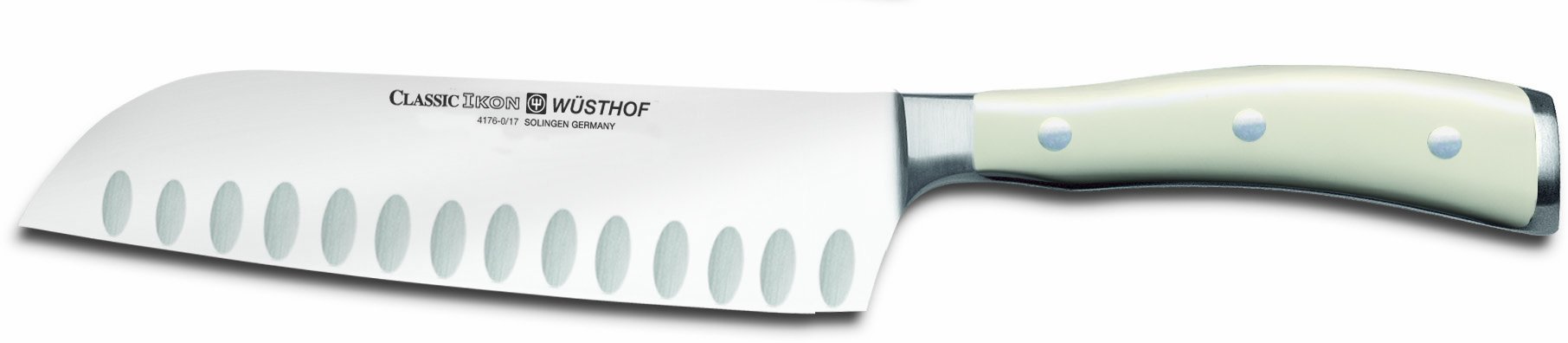
The Wüsthof Classic Ikon is the canonical answer when someone wants a serious German knife that will last a lifetime and handle everything from butternut squash to breaking down a chicken. The full tang, double bolster, and precision-forged high-carbon stainless blade are exactly what you want if your priority is durability under real kitchen conditions — including the occasional rough treatment. The edge is softer than a Japanese knife, which means more frequent honing, but it also means you can bring it back on a steel without sending it out. The Ikon's curved profile is optimized for rocking cuts, which is how most classically trained cooks work.
A good fit if you want a heftier, forgiving knife built for decades of hard use with minimal fuss about maintenance.

The Victorinox Swiss Classic is the answer to 'I just need a knife that works and won't disappoint me' — it's one of the most honestly useful knives at any price point, not just at $47. The stamped blade means it's lighter and less substantial than a forged knife, but it sharpens easily, holds an edge respectably, and the ergonomic handle is comfortable for extended prep work. Culinary students and working cooks reach for Victorinox because it survives the kind of daily punishment that would embarrass more precious knives. It won't give you the excitement of a fine Japanese blade, but it will still be cutting well twenty years from now.
A good fit if you want an unpretentious, genuinely durable workhorse that performs well above its price and doesn't require any special care.

Zwilling's Pro line uses the same X50CrMoV15 German steel that's become an industry benchmark — well-balanced, durable, and predictable in all the right ways. The knife has a slightly curved bolster that encourages a proper pinch grip, which is either a thoughtful ergonomic detail or an unwanted constraint depending on your technique. Zwilling has been making knives in Solingen for nearly 300 years, and the professional repair and maintenance network that comes with that legacy is genuinely useful for a knife you intend to own for decades. It's not as exciting as the best Japanese options or as sharply differentiated as the Wüsthof, but it's a thoroughly competent, well-supported knife.
A good fit if you want a classic German forged knife with a long institutional track record and accessible professional support for long-term maintenance.

The Opinel No. 8 isn't a chef's knife in the traditional sense, but it belongs on this list because it represents something genuinely rare: a sub-$20 tool with an unbroken 130-year design history, field-repairable with basic stones, and capable of developing a protective patina that makes it more functional with age. French home cooks have kept Opinels for lifetimes, and the wear pattern on an old blade — the gentle inward curve from decades of sharpening — is a kind of functional beauty. The carbon steel needs drying after use and will spot if neglected, but for someone who wants to understand knife care or needs a capable everyday slicer at minimal cost, it's hard to argue with.
A good fit if you want a genuinely long-lived carbon steel blade at minimal cost, or are curious about patina and maintenance without a large commitment.

The Victorinox Fibrox is essentially the workhorse version of the Swiss Classic with a more utilitarian rubberized handle designed specifically for professional kitchen conditions — wet hands, long shifts, repeated use. It has a long track record in commercial settings where knives get used hard and sharpened frequently, and Victorinox's repair and resharpening support adds genuine longevity in practice. The Fibrox handle divides opinion aesthetically, but it's grippy, hygienic, and purpose-built for the conditions most home cooks never push toward. At this price, the durability-to-cost ratio is nearly impossible to beat.
A good fit if you want a no-nonsense knife built for heavy use and don't care about aesthetics as long as it keeps working.

This is the MAC MTH-80 in its higher-end Professional Series configuration — same celebrated geometry and molybdenum-vanadium stainless steel, but positioned as a more deliberate purchase rather than a casual one. The knife that turned a generation of serious home cooks onto Japanese-influenced design, it earns consistent praise from people who compare it directly against German alternatives and find the difference in cutting feel immediately obvious. MAC's heritage and accessible sharpening support mean this is a knife you can actually maintain for life rather than one that sits unused once the edge degrades. The price bump over the standard version is a statement of intent as much as a spec upgrade.
A good fit if you're ready to commit to a proper knife for the long haul and want something that rewards skill and care with noticeably better performance.

The Tojiro DP Cobalt Alloy is a step up from the entry-level F-808 and one of the better-kept secrets in mid-range Japanese knives — the cobalt alloy steel offers noticeably better edge retention and corrosion resistance than standard stainless, which means longer periods between sharpenings and less anxiety about moisture. Enthusiasts who know their way around Japanese cutlery consistently recommend it as the value benchmark in its category. The tradeoff is that it demands more careful technique than a German knife — this isn't the blade you want near bones or frozen food — but for everyday prep it's a genuinely impressive performer at its price.
A good fit if you've already decided you want a Japanese-style knife and want the best edge retention available before the price jumps significantly.
How to choose
The first decision is steel philosophy. German forged knives use softer stainless steel that can take a beating — tossed in a drawer, run over a cutting board edge, used for tasks a knife shouldn't do — and bounce back with a quick honing. Japanese knives use harder steel ground to a more acute angle, which means a dramatically sharper edge out of the box and between sharpenings, but one that chips rather than rolls when abused. If you cook daily and aren't precious about your tools, German makes sense. If you find knife care satisfying and want a cutting experience that feels noticeably different, Japanese steel is worth the discipline it asks for.
Within those camps, blade geometry matters more than most people realize. A thinner blade with a lower edge angle glides through food with less resistance — this is why a good Japanese knife feels like it's barely there on a soft vegetable. A thicker German blade handles hard squash, bones, and rough prep without complaint. Neither is wrong; they suit different cooking styles. If you rock-chop, a curved German profile is your friend. If you push-cut or use a forward stroke, a flatter Japanese profile gives you more precision.
Handle construction and material determine how the knife ages over twenty years, not just how it feels in the store. Full-tang construction with riveted handles is the traditional durability benchmark — the blade steel runs the full length of the handle, and replacement is straightforward if needed. Stainless or composite handles outlast wood in wet kitchen environments without any maintenance. Wood handles look and feel great but need occasional oiling and don't like the dishwasher. Any handle that feels right and is properly attached will outlast you if you sharpen the blade.
On price: the relationship between cost and longevity breaks down quickly above $200. A $47 Victorinox with a stamped blade will outlast a $300 fashion knife with poor geometry if you keep it sharp. Past a certain threshold — roughly $150 to $200 — you're paying for specific steel properties, artisan production, or aesthetics, not raw durability. That's a legitimate reason to spend more, but go in clear-eyed about what you're buying.
Things worth knowing
- → German steel rolls its edge under abuse while Japanese steel chips — the difference matters less if you're careful and disciplined, but dramatically more if your knife ever meets a ceramic plate, a hard seed, or a drawer full of other tools.
- → Edge retention between sharpenings is meaningfully better on harder Japanese steel, which matters if you cook frequently but sharpen infrequently — a knife that stays sharp through a month of daily cooking is functionally more useful than one that's theoretically sharper on day one but dull by day ten.
- → The weight and balance question is deeply personal and affects fatigue over a long cook: a heavier forged German knife feels reassuring and stable for heavy prep, while a lighter Japanese knife rewards precise technique and reduces wrist strain during repetitive tasks like julienning or herb work.
- → Repairability and sharpening access are underrated longevity factors — a knife with an established brand behind it, accessible sharpening services, and a wide community of people who know how to maintain it will last longer in practice than a technically superior blade that gets neglected because its owner doesn't know what to do with it.
- → Budget and longevity correlate up to a point, then diverge sharply: a well-maintained $50 knife with good geometry outlasts an ignored $400 one, and the most expensive options on this list justify their price through steel character and craftsmanship, not raw durability over a cheap alternative.